Great Decisions
1/14 American Options in the Middle East
The Trump administration's war with Iran marks another major upheaval in the United States' fraught strategic relations with the region. Looking beyond the day-to-day military dangers and diplomatic maneuvers, what are America's major grand policy options for the region? What are America's choices? Is there a sustainable path forward that allows the United States to remain a security ally to Israel and its Arab allies in the region, while dealing with Iran's nuclear threat and proxy provocations across the region? Is there a path that allows the United States to deescalate its role in the region and rebalance its military commitments, doing so in the face of a rising China and other pressing regional demands? What are America's interests in the Middle East and how are they best advanced and defended?
Henry Berman is a retired businessman, working for 34 years at Ecolab, a global company based in St Paul. Henry has personal ties to the Middle East Region and has spent much time there in the last decade. He has a strong interest in the ever-changing dynamics in this turbulent part of the world, including the emerging continent of Africa and Southeast Asia. Henry is a member of the Council of Foreign Relations and is active in a local Great Decisions Group. He has given popular presentations throughout Minnesota on such varied topics as Saudi Arabia, Future of the Kurds, Egypt and the Arab Spring, Syrian Refugee Crisis and the U.S.- Israel relationship. Henry has a BA from Hamilton College and an MBA from the Tuck School of Business at Dartmouth College.
____________________________________________________________________________________________
2/8 American Foreign Policy and the Future of Multilateralism
Over the postwar decades, the United States played a leadership role in building multilateral regimes and institutions across a wide range of policy areas. It was a founder of the United Nations and champion of the Bretton Woods system, and during and after the Cold War, Washington played an important role in fostering multilateral agreements in trade, public health, environment, foreign aid, and humanitarian assistance. To be sure, Washington was often an ambivalent multilateralist, seeking at various junctures to protect its sovereignty and policy autonomy and exercise power unilaterally. Today, multilateral cooperation is at a low ebb. What is the future of multilateralism, and what are America’s choices? Does supporting and operating within multilateral frameworks for cooperation still serve America’s interests, and what might the agenda be for rebuilding the global system of multilateralism?
Todd Lefko is President of the International Business Development Company, an import-export firm operating in various sectors, including water purification, art, and new technologies. Having worked in Russia for over 32 years, he maintains homes in both Minnesota and Moscow. He has authored over 680 articles for Russian publications, serves on the editorial board of the Russian Historical Review, and has edited four books. Todd has taught courses in sociology, political science, and international relations across Minnesota universities, alongside lecturing internationally. He holds a Master's in Public Administration, completed doctoral coursework at the University of Minnesota, and co-founded Global Volunteers.
______________________________________________________________________________________________
3/22 The Future of Germany in Europe and the Atlantic World
Germany has tied its foreign policy to Europe and the Atlantic alliance, fashioning what some have called a civilian great power role. The Russian war on Ukraine, the return of the Trump administration, and the rise of right-wing movements on the continent have shifted the ground upon which German politics and foreign policy operates. This essay explores the changing debates inside of Germany about its leadership role in Europe, relations with the United States and NATO, and its standing and identity as a great power. What is the future of US-Germany relations, and what choices do Washington and Berlin face in giving shape to those relations?
Dr. Richard Leitch is an Associate Professor in Political Science, Environmental Studies, and Japanese Studies at Gustavus Adolphus College, where he has taught since 1996. After a brief career on Wall Street, he earned his M.A. in Asian Studies and Ph.D. in Political Science from the University of Illinois. His course offerings span International Relations, Comparative Politics, Asian Politics, Environmental Politics, and the Politics of Poverty. A widely recognized educator, he has received multiple top honors for teaching excellence, including being named one of The Princeton Review's Best 300 Professors in 2012. His research focuses on Japanese domestic politics and foreign policy, and he co-authored Japan's Role in the Post Cold War World.
______________________________________________________________________________________________
4/12 Richard Lietch - U.S. China: The Case for Engagement
The trajectory of US-China relations in the years ahead will be a defining feature of world politics. In a two-superpower world, rivalry and conflict may, to some extent, be inherent and inevitable. But what might be the terms for a more constructive relationship? Can the two countries build guardrails to prevent high-risk, security dilemma-driven conflict? In what policy areas might Washington and Beijing find opportunities to cooperate? What are the choices that the United States faces in forging a steady and sustainable grand strategy toward China? What principles of international order — starting with Westphalian norms of sovereignty and power management — might provide the basis for Washington and Beijing to negotiate the terms for a wider consensus among states in East Asia and the wider world about international order?
Dr. Richard Leitch is an Associate Professor in Political Science, Environmental Studies, and Japanese Studies at Gustavus Adolphus College, where he has taught since 1996. After a brief career on Wall Street, he earned his M.A. in Asian Studies and Ph.D. in Political Science from the University of Illinois. His course offerings span International Relations, Comparative Politics, Asian Politics, Environmental Politics, and the Politics of Poverty. A widely recognized educator, he has received multiple top honors for teaching excellence, including being named one of The Princeton Review's Best 300 Professors in 2012. His research focuses on Japanese domestic politics and foreign policy, and he co-authored Japan's Role in the Post Cold War World.
______________________________________________________________________________________________
4/26 Gary Prevost - Brazil and the Global South: Confronting a New America
Under the banner of America First, Donald Trump has redefined the country’s relations with the rest of the world, including Brazil and the Global South. Two years into Trump 2.0, what are the responses of Brazil and the Global South to American foreign policy? What sorts of judgements are Brazil and other countries outside the old Western order making? What are the choices that Brazil faces in this shifting geopolitical environment — both in its global relations with China, Europe, and the rest of the world, and within the Western hemisphere? Can Brazil and the United States forge a stable and mutually beneficial relationship in the years ahead, and if so, what would be its terms? What sorts of relationships between Brazil/Global South and the United States might be built in the aftermath of Trump 2.0?
Gary Prevost is Professor Emeritus of Political Science and Latin American Studies at the College of St. Benedict/St. John’s University and Research Associate and Honorary Professor at Nelson Mandela University in South Africa. He is the author of twenty books and more than 100 academic articles with a primary focus on Latin America and South Africa. He has taught courses in international relations and U.S. foreign policy for more than fifty years and is a long-time contributor to the Great Decisions program.
______________________________________________________________________________________________
5/10 Isaac Russell - AI and American Choices
AI is the leading edge of a technological revolution that is shaking the world. How will the AI revolution, and its associated economic, technological, military, and political transformations, alter the terms of international relations? What are America’s national security and foreign policy choices in this area? As with the nuclear revolution, the United States faces national security incentives to both use the AI revolution as an instrument of national power, and to seek ways to regulate the international dangers of the new technology. Are there opportunities for the United States to lead in building international rules and arrangements to exploit the opportunities of AI and guard against the worst dangers? For American foreign policy decision-makers, what choices will the country face in dealing with this rapidly unfolding technological revolution in the years ahead?
Isaac Russell is a government relations professional and international affairs specialist with over a decade of policy and legislative experience. He holds a Master’s in Public Policy from the Humphrey School, where his academic scholarship focused on realist theory, Russian foreign policy, and Balkan geopolitics. Professionally, he serves as a lobbyist at Christopherson Advocates, representing business and nonprofit clients across the Twin Cities. His prior career includes nine years as a Minnesota State Senate legislative staffer, alongside senior leadership roles at the Center for Economic Inclusion and Allianz Life. Additionally, Isaac contributes to public discourse through articles for MinnPost and East-West Connections, promoting international engagement and citizen diplomacy.
______________________________________________________________________________________________
5/24 Speaker TBD - Energy Security: Challenges for American Foreign Policy
The American/Israeli war with Iran and the ongoing blocking of the flow of oil from the Strait of Hormuz has triggered a crisis in the global oil and energy economy. For all regions of the world, the basic terms of energy security have been rendered unstable and uncertain. Not since the 1970s have the entanglements of oil, energy, and geopolitics been so fraught. How should American foreign policy decision-makers think about the problem of energy security in today’s world? What are America’s choices? What new global energy realities frame these choices? After Trump, if the United States wanted to again step forward as a global leader in this area, what should it seek to do? What allies and partners might the United States work with in advancing national and international energy security?
___________________________________________________________________________________________________
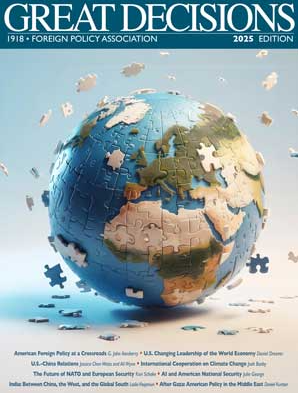
The Great Decisions program provides background information and policy options for the eight most critical issues facing America each year and serves as the focal text for discussion groups across the country. The Great Decisions program was created by the Foreign Policy Association. The mission of the Foreign Policy Association today, as it has been for over 100 years, is to serve as a catalyst for developing awareness, understanding, and informed opinion on U.S. foreign policy and global issues. Through its balanced, nonpartisan programs and publications, the FPA encourages citizens to participate in the foreign policy process. Please read the Foreign Policy Association descriptions here: FPA announces Great Decisions topics for 2026
Edina Community Ed's Great Decisions programming is co-sponsored by Global Minnesota and Edina Community Ed and funded by the Edina Friends of the Library.
600-1
| Date | Time | Location |
|---|---|---|
| Mon, Jan 4th 2027 | 4:00 - 5:30 PM | Edina Community Center |
600-2
| Date | Time | Location |
|---|---|---|
| Mon, Feb 8th 2027 | 4:00 - 5:30 PM | Edina Community Center |
600-3
| Date | Time | Location |
|---|---|---|
| Mon, Mar 22nd 2027 | 4:00 - 5:30 PM | Edina Community Center |
600-4
| Date | Time | Location |
|---|---|---|
| Mon, Apr 12th 2027 | 4:00 - 5:30 PM | Edina Community Center |
600-5
| Date | Time | Location |
|---|---|---|
| Mon, Apr 26th 2027 | 4:00 - 5:30 PM | Edina Community Center |
600-6
| Date | Time | Location |
|---|---|---|
| Mon, May 10th 2027 | 4:00 - 5:30 PM | Edina Community Center |
600-7
| Date | Time | Location |
|---|---|---|
| Mon, May 24th 2027 | 4:00 - 5:30 PM | Edina Community Center |
No matching options. Try adjusting your search or filters.